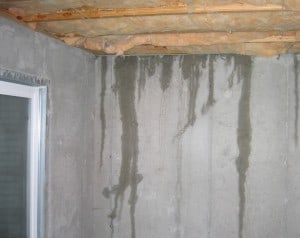
basement waterproofing

Leaves fill and block gutter in Toronto homeDid you know that a faulty eavestroughs system can create a leaky basement?

In a perfect world, water would flow smoothly off roofs into gently sloping gutters (or eavestroughs as us Canadians sometimes call them). From there, it would pass down pipes into drains, or runoffs that lead it safely away. Direct beneath the gutters lie the outside walls of cellars. If the system fails, most of what the roof sheds could permeate down and flood your basement.

Root Causes of the Problem

Basement waterproofing is expensive, especially when retrofitted after the fact. It’s far better to attend to contributory problems than to try to stem the consequences. The following are the main things to look out for. If the problem persists, then you may need specialist advice.

WARNING – Do not attempt to scale a ladder or climb a roof without assistance. It’s a long way to the ground, and you might invalidate your insurance.

Blocked Gutters – The biggest single problem with gutters is that you can’t look into them directly, without going up a ladder or climbing onto a roof. Moss can build up quicker than you think, as may leaves and windblown dirt. A rubber ball can speed the process up. In winter, an ice dam can rapidly block them. In no time at all, your gutter could start looking like a garden. When this happens, it’s time to call assistance in.

Broken Gutters – Gutters don’t last forever. A bracket can snap off in a storm causing them to sag or crack. Older iron or plastic ones can rust through or decay. When this happens, they do the opposite of what’s intended. They soak the foundations of your home and flood the basement. If this happens, then you need new gutters.

Downpipes – These are your next port of call, as they can easily become blocked by debris flowing through the eavestroughs.  This is especially likely at the angled points at top and bottom. In this case, you can often clear them with a hosepipe. If not, then you need to have then removed, cleared and replaced.

Runoffs – After you’ve attended to all these issues you should have rainwater flowing through the downpipes every time it rains. Aiming this at a single point on the ground erodes foundations and is about the worst thing any basement wants. The solution is simple. Order in some concrete runoffs, and lead the rainwater safely far away.

broken run off extension for gutter in Scarborogh home


If This Doesn’t Work

You probably clicked on the link to this article because you have a leaky basement, and were wondering whether your eavestroughs were to blame. If they were, then the above advice should get you well on the way to solving it.  As you can see, with a few fixes and some regular maintenance  you can keep runoff rain water away from your home, and out of your basement.

If the root of your leaky basement isn’t your eavestroughs, then your problem could be more deep-seated. Uncontrolled underground water can play havoc with the structure of your home and basement.If you have any questions about water entering your basement, feel free to contact us, we’re happy to answer any questions.

Ice damming on Toronto roofDo you have a giant sheet of ice on your roof waiting to wreck havoc on your home?  The last few Winters here in Toronto have been a mix of warm days and freezing days, the perfect storm for ice dam formation.  Ice dams can not only damage the outside of your house, they do a lot of damage inside as well.

When snow falls on rocks and trees it comes in contact with something perhaps even a little colder and does not melt. It builds up until a combination of gravity and weight causes it to slip loose, and fall harmlessly to the ground. If on the other hand it falls on something warmer then it melts, and either dams (freezes again before it drips off) or runs off as water depending on the gradient.

How Do Ice Dams Form?

Here in Toronto, we go to great expense to warm their homes in Winter and that’s perfectly understandable. Unfortunately heat rises and despite best efforts at ceiling insulation some heat is inevitably transferred to the attic. This can be a result of inadequate insulation, or gaps caused by pipes and trapdoors. With the best will in the world, nature will always have a way, meaning that your attic will inevitably be a little warmer than the winter air outside.

This temperature difference causes the snow to gradually melt and travel down the roof. When it reaches the eaves that are at ambient temperature it freezes again, and gradually forms into a ridge. Above, the snow keeps on melting and adding to the pile of ice. As this grows in size the melt water becomes a dam pooling on the roof. Ice dams are a roofer’s worst nightmare come true.

This is because roof coverings work on the assumption that water will run off before it has time to seek out crevices and work it’s way under the shingles. This problem is surprisingly common on most roof surfaces except corrugated sheet metal. It’s worst of all on flat roofs and shingles.

Ice dam on home in Scarborough

Referred Problems

Ice damming on roofs inevitably finds its way into the roof space below. There, it drips quietly onto insulation and accumulates on ceilings. If the leak is serious this can lead to minor flooding and damage to ceilings, carpets and upholstery. If the problem is minor then the attic becomes dank and starts smelling of mold.

The mold spores find their way past cracks through which the heat transfer happens. As they do so, they find themselves in an almost perfect habitat where they can procreate to their hearts content.

Tackling to Root Cause of Ice Dams

Ice dams exist because of differences between ambient and attic temperatures. Your wisest first point of call is to inspect your attic insulation because it’s pointless generating heat to melt the snow above and cause these problems. You may require expert advice because the problem’s probably lurking in an almost inaccessible place.

Your second line of defense is to improve ventilation through your roof so you constantly exchange the warmer air for cold. Point being, keep the attic as cold as the air outside. This can be effective in the case of steep roofs with gable ends. If you have a badly pitched roof covered with tiles or shingles you could be up for expensive alterations.

Have questions about ventilation and air quality inside your home?  We’re happy to answer and questions, you can contact us here.

Exterior waterproofing Toronto

Exterior or Interior waterproofing for your basement.  Which one do you choose?

There are two schools of thought about keeping water out of a basement. One viewpoint believes in stopping it at source. The other lets in it and manages it away. To me it’s a simple matter.  Your first choice is to always fix it from the exterior.  If that’s not possible due various reasons (other homes will be affected, inaccessible area, etc), then an interior waterproofing solution will need to be implemented.

Waterproofing Defined

The dictionary states that “waterproofing” is the act of making something impervious to water. Backpackers waterproof their packs and tents so water can’t get through them. Admitting water into basements and managing it away is the opposite of waterproofing. It’s more of basement water management.

Waterproofing Basements

Waterproofing basements is about denying water access. Anything less is called something else. The process involves:

1  Putting catchment drains on the exterior of the basement at floor level to lead water filtering down away.


2  Treating the outside of the walls with a waterproofing compound or membrane


3  Backfilling the space outside the basement with quality soil, not builder’s rubble


4  Hard-surfacing the result and making sure water can’t pool on it.

This approach applies probability theory to the waterproofing paradigm. For example let’s say the likelihood of water pooling is 5% and that of the waterproofing 1%. The probability of both happening is .05% which is marginal.This belts and braces approach is used all the time.

What Doesn’t Work

The process I just described is specialized. It comes at a cost because digging out and fixing leaking basements properly does take time and is definitely an investment. Some folks prefer to try to skirt the issue by getting an interior waterproofer.  Some companies that claim that all of your basement water problems can be solved from the interior is just flat out wrong.  Applying some sealant on your basement wall won’t do much when water (under pressure) is pushing through cracks and seals in your wall.  You may be able to manage the flow of water once it’s inside the basement, but that’s not waterproofing, it’s water management.  It’s hard to have a dry, finished basement when you have a stream running inside it.

For Small Leaks 

For very minor leaks and cracks, sometimes an interior solution will work, especially if the exterior fix is not an option.  Sometimes they work and sometimes they don’t.  The important thing to know is that the water trying to make it’s way into your basement is under hydrostatic pressure, and is constantly trying to push it’s way through any crack or pore it can get into.

Another Option

If you’ve been through all that and don’t have enough money left over to waterproof your basement properly, then you could try installing weeping tiles and a sump with a pump. In simple terms this involves chopping out a perimeter drain in the basement floor, and using this to lead the water to a deeper point called a sump.

After that you install a submersible pump to remove the water to someplace outside. This is fine if you use your basement as an unfinished space you don’t plan on using for living purposes. But do you really want this in your living space as you’re missing out on a big part of your home that could be a great source of family fun.

Have questions about water problems in your basement?  Contact us here, we’re happy to answer any questions you may have!


leaking basement where foundation meets first floorWinter in Toronto is cold and wet.  The thawing periods in between the freezing weather is where many basement starts to show signs of leaks. AS accumulated snow and ice start to melt, it makes it’s way into the earth, leading to basement leaks. Of course,  It can come from a number of areas, including sources inside your home.  Each problem has it’s own potential solution,
Almost every basement leaks from time to time, especially if it’s never been properly waterproofed from the exterior. It’s a natural phenomenon because building materials are porous unless treated properly, and structural cracks develop as the ground settles over time. This leaves important clues for anybody who knows what they are about. You just need to think logically about what causes dampness, and which of the following apply to you:

1- If your basement ceiling is moist then the water is likely coming from a drain or water pipe above, that could have sprung a leak. Alternatively, your problem could be the consequence of warmer air condensing on cooler pipes and dripping down. These are simple problems the average home handyman can probably fix themselves.

2- Surface water is a common cause of signs of damp on upper basement walls. It’s often caused by rain and flooding. If you allow water to pool on the surface, then the earth will absorb it because that’s what soil does. Where else do you think tree roots get their water from? It’s easy to figure out you need to lead storm water away from the walls of your house, especially near your basement location.


If the surface slopes towards your home then you need to re-grade it to a fall of one inch to one foot away from it. It will help greatly if you pave the immediate area too. This should deal effectively with damp showing in the upper parts of your basement walls. Don’t forget to clean out your window wells at the same time too.


  1. Ground water is usually the driver behind damp on lower basement walls and floors. This is moisture that travels through natural earth strata from elsewhere to your home. If your house is standing on a rise you shouldn’t have it. If it’s in a hollow then it’s inevitably there in winter. This is what causes damp on lower walls, and seepage through the joint between the walls and floor.

This is a tougher nut to crack, especially because problems behind walls and under floors that are hard to get to. If the leakage is radical you might have to excavate from outside and install the drainage systems builders call french drains and weeping tiles. If it’s minor, then a sump pump system might suffice.

It’s simpler when you understand the basics. However many of the cases we’ve dealt with had multiple causes that overlap. The best course of action is to look for the simple solutions and work your way back. If problems persist you’ll most likely want to call in a basement waterproofing company to conduct a full assessment of your water problems.


So far this Fall we’ve been pretty lucky up here weather wise in Toronto.  With a warmer than usual Fall and being fortunate enough to miss hurricane Sandy’s ugly path, Winter still seems like it’s a ways off from us.  But we all know that Canadian Winter is coming, she’s just taking her time this year.

If you haven’t done so already, be sure to spend a weekend afternoon going through your home and preparing it for the coming cold.  As a waterproofing company here in Toronto, one of the most important steps you can take as far as avoiding water leaks in your basement over the Winter is to examine and clean out your gutters before the snow and ice come.

Some of the things you should check for are making sure the Fall leaves have been removed and won’t clog your downspouts.  If water and ice start to accumulate due to a clogged downspout, you run the risk of water leaking over the top of the gutter (or through cracks and leaks that develop) and that water accumulating around the perimeter of your home.  What happens is that on warmer Winter days, that accumulated water starts to make its way through the tiny cracks in your basement’s foundation.  Also make sure that your downspout extensions are directed far enough away from your home so water doesn’t start to accumulate in the soil around your foundation.

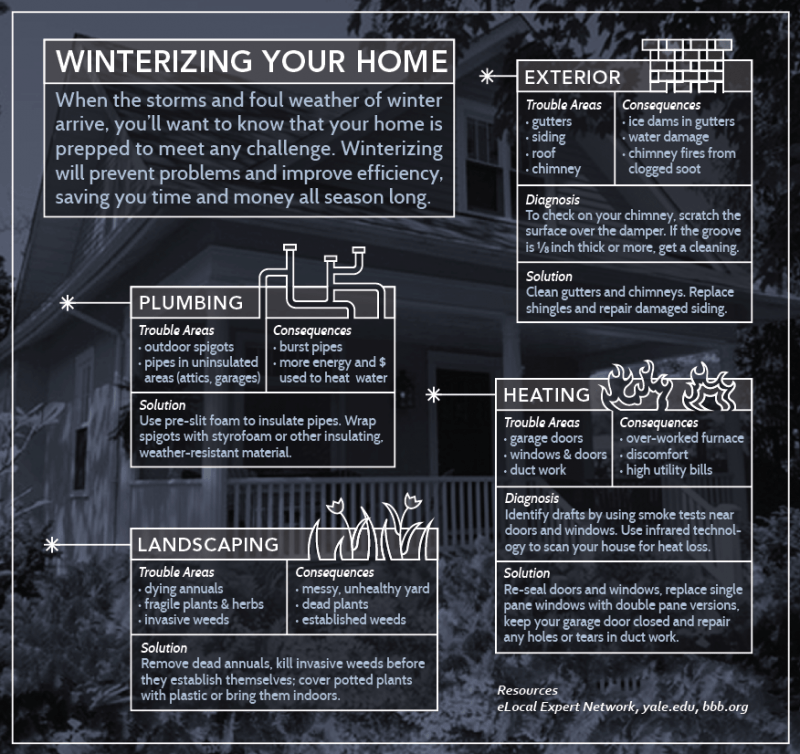
While we are the waterproofing experts here in Toronto, there are other things you should do before the freeze sets in.  Check out this infographic courtesy of elocal.com for a quick and handy checklist of things you should do to Winterize your home.

Winter checklist Toronto home