basement waterproofing

Do you have bugs living in your basement?  Of course you do, it’s the perfect environment for the little creatures….damp, dark, and lightly inhabited.  While bugs are harmless, they do have a certain creep factor, especially when you turn on the lights and notice little things scurrying for cover.

Tip: If you see lots of spiders in your house, you also have lots of other bugs crawling about as that’s what they are feeding on.

Bugs cannot survive long without a constant source of moisture. They also like dark places where they can scuttle away from predators. Fortunately, the ones you find in a damp basement are generally not dangerous. However, the permanent moisture they signify is a more serious matter. Here we list the 5 most common basement bugs you will find when moisture is present.

Silverfish

Silverfish in Toronto homeSilverfish (otherwise known as fish moths) are silver-grey creatures that can grow to one inch long. They are nocturnal meaning that you are unlikely to spot them unless you disturb them. Sometimes you will find them wriggling in an empty bathtub in the morning. In our homes, they live on paper, fabric, coffee, sugar, human hair and clothing. Trying to kill them directly is pointless. Use a spray that leaves a residue.
 

Centipedes

centerpedeThe Latin word means a hundred feet. Some have more, some have less and they come in all shapes and sizes. They are carnivorous meaning that they eat meat (do not stress, their jaws are tiny). You can control them by keeping the house clean. Killing them is messy. Rather stun them with a rolled-up newspaper, catch them in a jar and turf them outside where they belong.
 

Mold mites

Mold mites in TorontoIf you have a damp basement, you can safely bet that you have mold too. You can also rest assured that you are harbouring a colony of mold mites. They are tiny creatures you might not even spot, as they go about their business of feeding on your cheeses, meats, nuts and seeds. You can kill them to your heart’s content by squashing them. There is only one long-term solution. Get rid of the mold.

Earwigs

earwig-basementIn a forest, you find earwigs by the dozen under any rotting tree. You will find them in a damp basement too, although you need to be up at night with a torch, because they are nocturnal. They scuttle out of cracks to feed on a variety of insects and plants. If you do not like using poison, keep rotting vegetation away from the perimeter of your home.
 

Sow Bugs

WoodlouseSow bugs are also known as woodlice (and armadillo bugs because of their habit of rolling up into a ball when frightened). They serve a useful purpose in our gardens where they generate compost and loosen up the soil. If it is dry outside, they may invade a damp basement in surprising numbers, although they are not serious household pests. Getting rid of them can be a challenge. Your best defence is eliminating the damp and moisture that they love.


The “Final” Solution

You will never get rid of insects permanently in the house. In fact, the bugs will still be lurking around the basement long after you’re gone. In the interim, there are two ways to manage them in a damp basement. The first is to deploy a team of spiders. Yes, spiders are great at catching and eating insects. The second is to eliminate the source of moisture and to make the basement less hospitable for your creepy crawler roommates.

Have questions about how to fix your damp basement?  Feel free to contact us today for a free in-home inspection and estimate.
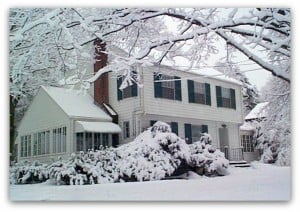
Have you ever wondered why Toronto basements seem so much more prone to leakage than, say, basements in Los Angeles? While there are many factors that go into why a basement leaks, Toronto seems to help in creating the ideal conditions for a leaky basement. As Toronto natives ourselves (and basement experts), we’ve pondered this question and came up with five main reasons:

Toronto home in Winter

 1) Weather

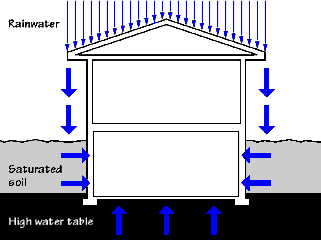
As you can probably guess, our wonderful weather is the number one factor that creates opportunities for basements to leak.  In the Spring and Fall we get lots of rain and in the winter we get lots of snow and ice that freezes, thaws, and melts over time causing buildup around foundations. In other words, Toronto basements leak because the soil surrounding the foundation and the walls of the basement become overly saturated.  The leaks aren’t as noticeable when the weather is dry, but soil packed deep into the ground can take months to dry up.


2) Age

Toronto is an older city, which means that many houses have been constructed several decades ago. Old Toronto basements weren’t intended to be living spaces and many of them are actually less than 5 feet high! While there is no arguing that older homes are oozing with character and charm, we’ve found that older foundations are often poorly constructed with thin walls and multiple cracks in the foundation. This, unfortunately, means that inadequate drainage outside can easily penetrate floors and walls, causing water damage and annoying leaks.


3) Backed-Up Sewer Pipes

Many older Canadian homes still have storm water run-offs connected to their sewer lines. The problem often presents itself with an overflowing toilet, which can mean that it is necessary to modify the drainage system. While this usually affects toilets, other fixtures such as tubs and showers can also be involved.


4) Water

Toronto is built on an advanced river system, with lots of water under the city with hundreds of hidden rivers running under it.  It’s a water rich area, and in some areas rising water tables could be the problem causing basements to leak.  While the water table below a home may be several meters below the foundation, that doesn’t mean that it won’t cause water problems in the basement.  However, water doesn’t always seep down consistently. The degree of existing saturation, the permeability of the strata, and the presence of impermeable rock are factors that affect water penetration.


5) Gutter System

Lastly, gutter systems often cause Toronto basements to leak. Since old and poorly installed gutters tend to promote pooling water, it’s not uncommon to find a build-up of standing water around the foundation of your home. With nowhere else to go, the water will leak into the basement, eventually penetrating the walls and causing serious damage.  Lets face it, here in Toronto the gutters on our home take a beating during the course of the year.


Basements leak for many reasons 

There are numerous reasons that Toronto basements are prone to leaking, but weather, age of the home, backed-up sewer pipes, water, and gutter system issues are usually the main culprits. The good news is that you are not alone in this and there are many ways to fix the leaking issue and ensure that it doesn’t happen again.

Have a question about a basement leak in your home?  Feel free to contact us for a free in-home estimate and inspection.

White powder basment wallIn a word, it’s called efflorescence. When people see it on their basement walls, they often refer to it as the white powdery stuff, white mold, or white mildew.

The white stuff you have on your basement walls, officially called efflorescence, is actually a deposit left behind by water. You may have noticed it on the outside of your house walls too (hopefully below the damp course, that is). The stuff is normally harmless, although you’re still advised to wear hand and face protection when you brush it off, just in case.

The big question is “why is there water there in the first place?” Walls are supposed to be dry. Having damp walls is a bad idea because the moisture could eventually cause the structure to begin to break down.

To answer the question we need to take a trip underground to the dynamic, natural world. Water – the source of life they say – is constantly on the move filtering through the earth and stone. As it travels, it picks up natural minerals and salts that it transports along and finally deposits someplace else. It’s almost as if sand and stone were made for the job!

Our homes certainly are. They are built from natural materials in the form of sand, cement and stone. Water passes naturally though these too, which is why we go to the trouble of baking bricks and painting outside walls with expensive waterproofing paint. We also add damp courses, roofs, gutters, downpipes and overhangs like eaves.

efflorescence-concrete-basement-wall-toronto

We do everything “upstairs” to keep the water away from our walls. Down in the basement it’s often a different story. When it rains the earth around the foundation becomes saturated. Many basements we’ve encountered are little better than “leaky buckets” rammed into the ground.

In a sense, efflorescence on an inside basement wall is like a friendly sentry-guard. It’s telling us that moisture is penetrating through our basement walls and leaving its customary calling-card behind. It’s likely to be historic evidence left behind as the moisture evaporated, which is why it’s normally more evident in dryer summer months.

This makes it the friend of home buyers too, especially when viewing the basement of a home in summer that’s subject to intrusive damp during winter time. The seller can try their hardest to brush it off, but there’ll always be a stain when you know where to look for it.

This is the biggest single reason to track down the cause of efflorescence if you have it in your basement, and to get rid of it before it starts working down the value of your home. It’s a sign that moisture is making it’s way inside your basement, and with that dampness often comes mold.

Not sure if you have efflorescence or not on your basement wall?  Contact us here for a free in-home inspection of your basement.


High water tables around Toronto HomesDo Waterproofing Paints Work?

When you think about it carefully, we usually waterproof things from the outside. That’s as much true for garments, as it is for leaks on roofs. Engineers understand that it’s futile trying to stop seepage through a crankcase joint. Yet some in the basement-waterproofing industry keep insisting that basement walls are an exception to the rule.

Why Basements Leak

Underground spaces leak when two conditions are true:

  • There is groundwater backed outside of them, and
  •  Hydrostatic pressure forces a way into them, via:
  1.  The material of which they are constructed, OR
  2. Cracks and openings through this material, OR
  3. A combination of these two defects working together


These conditions are endemic in most spaces above ground. The difference with basements is the groundwater that lies around them. Contractors should adjust for this when building below ground level. The fundamental problem is that they often simply don’t as most of the time they apply the minimum waterproofing standards allowed by law during construction.

The Right Way to Avoid the Problem

When rain falls to the ground a certain amount of it inevitably pools. The earth absorbs the water. After that, gravity takes over and forces it gradually further underground. This happens faster in recently disturbed earth around the outside of basements. When it reaches the undisturbed level it starts backing up. There’s little we can do to stop this once it starts. However builders can install management systems, such as a weeping tile system, assuming they know how.

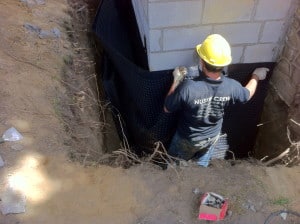
First and foremost, they are supposed to waterproof the outside basement walls with membranes that prevent the groundwater finding a way through the construction material – as well as any cracks and opening caused by subsequent ground movement. Most stop there, because they’re not thinking about hydrostatic pressure.

Waterproofing contractor in Toronto applying waterproofing membreane

This is the outcome of gravity bearing down on the column of water-laden earth that still backs up behind the water-proofing membrane. This can be sufficiently powerful to find a way through the slightest imperfection, filter through the building material and pour down the inside basement wall.

There is usually only one way to stop this, and that’s with an underground drainage system along the bottom of the basement wall outside and/or by applying an industrial grade waterproofing membrane along the outside of the foundation wall.. With minor leaks and cracks, the job and sometimes he handles from the inside, by repairing the foundation crack. Many homeowners are tempted to try water-proofing paint instead. While this does have its moments there are a number of limitations.

What Waterproofing Paint is For

Although “water-proofing” is something of a misnomer because the paint does not last forever, it does have some usefulness when applied to raw concrete when it can sink in and be absorbed. Under these conditions, it may be able to repel creeping damp for a few years. However it is no match whatsoever against determined hydrostatic pressure, which will easily work it’s way past any sort of paint sealant you apply on your basement walls.

It is also useless when applied to previously sealed or painted walls because its adhesive properties depend on absorption. Many a homeowner has paid to have it applied during the dry season, only to see it fail soon after the first heavy rain. In conclusion, the product is designed for repelling dampness, not for waterproofing against moisture flowing through your basement wall.

If you have any questions about a leak or damp problem in your basement, feel free to call us at 416-622-7000 or contact us via our web form.  We offer a 100% free Estimate and Inspection of your foundation.


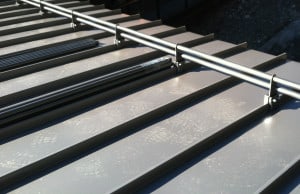
Snow rail on roof of Toronto homeSpring is the season when the majority of leaking basement issues occur. This is due in part to one obvious reason; Spring brings a lot of rain.  Rain gutters are the obvious solution to this problem, but what about the “not so obvious” problem that causes leaking basements? Snow for the past 3-5 months can actually cause more leaking basement issues than an early spring rain storm.

Throughout the winter, snow and ice will build up on your roof. If you have a roof with a slippery slope, such as a metal roof or tile shakes, the built up snow and ice will eventually slide off your roof. A lot of people believe this is a good thing because they do not want heavy snow and ice sitting on top of their home or business because they are afraid it will collapse their home or office building. The truth is building codes are written in such a manner that buildings properly constructed are able to handle the heavy load of snow and ice accumulated through the winter.

Roofing-infographic-toronto

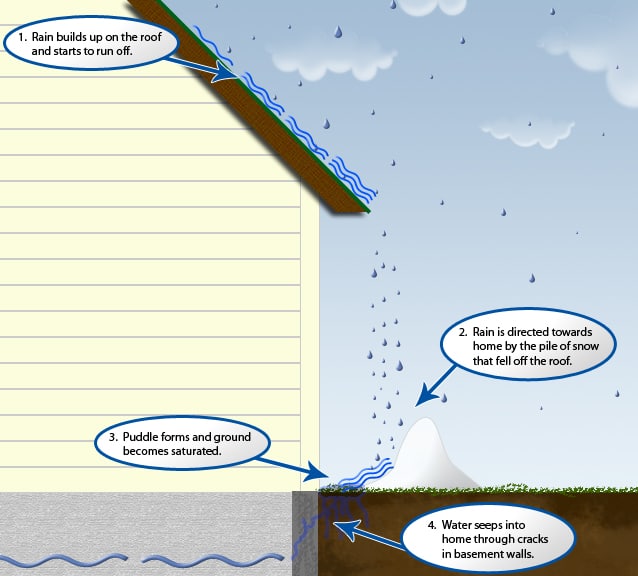
Allowing snow and ice to slide off your roof creates a mound of snow that builds up right at the base of your home. This is a problem. Sliding snow and ice also damages your roof, and rain gutters if you have them installed. This sliding snow and ice is so powerful that not only can it rip the rain gutters off the side of your home; if it hits someone it can actually kill them. Many a car has had the roof or hood caved in due to snow sliding off of sloped roofs.

Let’s get back to that mound of snow problem. The mound of snow that forms from the sliding snow creates two problems related to leaking basements. The first is the amount of stored water in the form of snow sitting right at the base of your home melts, saturating the ground. When rain comes along there is no more dry ground to soak up the fresh supply of water. Second, the snow creates a nice ramp for water running off of your roof. The problem with this ramp is that the downhill side of it is next to your home. Essentially this creates a funnel or channel leading right to your basement walls for the rain water that is falling. When a rainstorm comes, your roof now acts as a large collection basin sloping toward the “snow funnel” on the ground. Basically, nature has created a plumbing system for rain water to end up in your basement. This is not good.

So what can I do to avoid this problem?

There are products on the market to combat sliding snow and ice. These products are called snow retention systems. Snow retention systems consist of either a number of snow guards spaced out on your roof that act as several dams stopping the snow on your roof, or a snow rail system which is a long pipe or number of pipes attached to supports which also stops snow on your roof. Sno Gem and Sno Shield are popular snow retention manufacturers if you are interested in researching further into snow retention.

My neighbor installed the Sno Shield Panel Guard two years ago on one section of his roof over a window well where he was constantly having leaking basement problems. Last year we did not get any snow to speak of and he felt that he may have wasted money, but this year was a different story. We received several foot or more snow storms this year. Now we are at the end of March, and he was just telling me the other day after a large rainstorm that he can see no signs of leaking in his basement. The snow guards kept the snow on the roof allowing it to slowly melt and drip off. He said that it has been nice to be able to look out the basement windows this year and not see a sheet of plywood over the window well in an attempt to divert the runoff.

The best way to utilize a snow retention system to keep water out of your basement is combined with a rain gutter system. The snow is held on the roof where it can slowly melt. The run off is then properly guided away from your home via the rain gutter system or evaporates. The rain gutter system and anything else below the eave of your roof is protected by the snow retention lowering your potential liability and financial headaches.

About the Author

Written by Kade Smith. Kade is the owner of Roof Things located in Rexburg, ID. Roof Things is a roofing supply company found online at http://www.roofthings.com.