
basement waterproofing

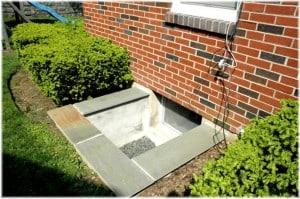
window-well-vaughan-ontario-homeAll the changes in our climate are causing more flooding in many areas. Toronto and the surrounding GTA has seen some serious flooding in recent years that has caused millions in property damage.  The basement windows in your home are a weak point where moisture can enter. This is extremely costly, particularly if the lower level of your home is finished.

If you already have window wells that protect windows at ground level or below, water will take the path of least resistance and pool in the wells. Often when there is a severe storm, water runs off the home, floods the window wells and large quantities of water then pour into your basement. Fortunately, there are ways to remedy this problem.

Installing a Dry Well

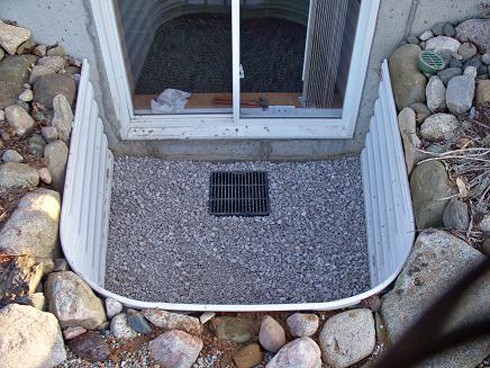
One of the simplest and most effective methods is to install dry wells around any windows that are flooding. A dry well works by improving the drainage around the window and routing water away from the foundation. Before you start the installation process, be sure that your gutters and downspouts are directed away from your existing window wells. Water should be directed to the lower side of your lot if it isn’t already. Check your local code requirements and be sure to purchase a dry well kits that are code appropriate for your area. The installation process is not that difficult, but very labour intensive and may require renting some heavy machinery. Homeowners often rent a bobcat or backhoe if they want to do it themselves.  To avoid damage to your property, you may want to consider hiring a waterproofing contractor that has experience with these types of installations.
window-well-dry-well-toronto-home

Options For Channeling Water Away From Your Foundation

There are two basic choices for diverting the water. The first involves digging a long trench far away from your home and directing the excess water into a perforated 50 gallon plastic barrel buried there. The water then slowly leaches into the soil instead of your basement. The second option is to pipe the water towards a sump pump which pumps the water away from the foundation. The first option is something that a do-it-yourselfer might want to tackle, but hooking into a sump pump is best left to the professionals as a special valve is needed to prevent backflow.

If you decide to try the barrel solution, you will need to dig a big enough hole for the well and a trench leading at least 10 feet away from your home. Make sure that the trench slopes away from your house. The plastic barrel can be perforated with a drill and it will need to be sunk lower than the pipe, so there is some serious earth moving involved.

Follow the instructions for installing the well itself. They are normally anchored to the wall, fitted with a drain, a cover and piping and then filled with pea gravel. Once everything is connected and tested, lay weeping tile along the trench and around the barrel and fill these areas with pea gravel.

The area around the dry well will need to be backfilled and replanted if necessary, but once completed it should be an attractive and effective solution to your water problem. Having a dry well is also a safer option in your home. Windows fitted with a dry well can be used as an alternative escape route if there are problems.

Installing a Proper Dry Well

If you are not sure if you are up for the challenge of a job this big or you think that you may have additional moisture problem, contact a professional waterproofing company. Nusite Group offers a free inspection and estimate on any waterproofing jobs and serve Toronto and the surrounding GTA.  We have over 35 years of experience and the equipment to do the job right the first time.
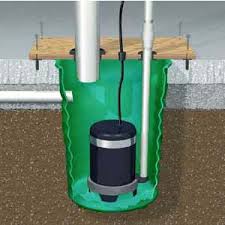
Toronto-sump-pump-drawingWhen you have a serious water problem in your basement, sump pumps can help. These pumps remove groundwater from around the foundation of your home. This is necessary when water tables rise quickly after a heavy rain or when large quantities of snow melt.

Looking at sump pumps is an overwhelming task. There are countless models and materials. However, there are some time and money-savings tips that can help you get the right unit at the right price.

Types of Sump Pumps

There are two basic types of sump pumps – submersible (underwater) or pedestal (above ground). Of the two, the submersible is the most effective as the pit that accumulates water comes with a cover so that it does not fill with debris. As well, the pump sounds are muffled by the cover and moisture trapped, rather than released into your home. While they are more expensive, they also have a longer usable life.

Make sure that the pump that you choose has a head pressure rating that will lift the water at least 10 feet. This is usually enough push to get the water out of your basement or crawlspace. The horsepower of the motor of the sump determines how fast the water moves out of your home. Some people opt for a larger motor, but these use more electricity and cost more to operate. However, the also minimize the chance of damage to your home. Most people find that a ½ HP pump is sufficient to do the job.

A good sump pump has a corrosion-free housing such as bronze, stainless steel or coated cast iron. The core should also be cast iron. Many economy pumps have plastic cores, but these do not dissipate heat and as a result the life of the pump is usually shorter.

sump-pumps-toronto-basement

What Switch To Use

There is some debate on what type of switch is the best for a sump pump. Many claim that a mechanical switch is superior as it is less likely to fail and burn out the pump. Others suggest that capacitive switches are better as there are no mechanical parts to wear out. Regardless of what type of switch the unit has, most water control specialists also suggest a secondary, or backup system in case of failure.

Finished Basements

If you have a finished basement or you store valuable goods in the lower areas of your home, a backup system can give you peace of mind. A backup system will turn on if the power or your primary pump fails. Usually the backup is battery-powered however some depend on high municipal water pressure (75 – 150 psi) to run the pump. These pumps are an automatic, independent system from the primary sump pump. If water rises above normal for any reason, a valve activates that draws the sump water up and ejects it to the outdoors. When the float drops, the pump stops after a pre-set time.

For those of you that feel that the do-it-yourself path is not for you, Nusite Group has experts that can help. We offer a free inspection and estimate for all your water control needs. Investing in a sump pump could save you thousands in property damage, but it is important that you choice the right one for the job. Our qualified technicians will explain which pump is best and why.

Finished basement with musty odourSpring is upon us, and you know what that means: melting snow. Keeping your basement dry is critical in your overall home maintenance to fight against mold, leaky basements, and property damage.
Contractors will often use a wide array of materials to help factor basement from membranes and drain boards, to perforated pipe, sump pumps, and more. One item that does not usually make it onto the list until you have problems, but nonetheless is equally as important to have, is a dehumidification system. If you’ve noticed changes in your home’s air quality or are worried about  it may be time to consider a dehumidifier.

A dehumidifier works to lower humidity levels by drying the air. A dehumidification system is often an asset not only for your basement, but for your overall living conditions. By maintaining good air quality in the lowest level of your home the effects are seen throughout the other levels of the home, based on the laws of physics in what is known as the ‘Stack Effect’. Dehumidifiers also work at drying out the invisible moisture that lies within the nooks and crannies, as well as the cracks of your basement. Studies have shown that even in the driest of basements, dehumidifiers can pick up over 10 gallons of water per day through sucking up moisture. Dehumidification is also essential when waterproofing your basement.

basement leak in Etobicoke homeThere are two approaches you can take when it comes to dehumidifying. The dehumidification process can be done with either condenser systems or venting systems. When selecting the option that is right for your basement there are factors you need to consider like the size of space, efficiency, temperature, and the goal of dehumidifying.

Let’s take a closer look at these two options:

1. Condenser Systems

A condenser system will decrease humidity by breaking it down into water. Condenser systems are a more common choice for homeowners, as some professionals If you are in the market for a condenser system experts recommend that a key factor to look for is a highly efficient system that also includes an air purification component. Although these factors may cost more initially, if your basement needs ongoing attention it has the potential to save you money. Condenser systems vary in sizes, while most small units can handle somewhere around 500 square feet of space whereas larger ones can do about 2500 square feet. For optimal performance condenser systems work best in conditions of 80° F and 60% relative humidity.

2. Venting Systems

A venting system will decrease humidity by venting the moist air back outside before it works its way up into your living space. The idea behind a venting system is that the increased ventilation decrease humid air, plus it will filter the moist air with drier air while exhausting odors. Where condenser systems work to condense moisture to water venting systems skip the process altogether, thereby making them more energy efficient. This premise has been highly criticized amongst pool professionals. Venting systems vary in sizes and can work with larger spaces up to 7000 square feet.

Don’t forget to consider the For best results, it is important to contact Nu-Site Group today for more information on sourcing the system that is right for you. Nu-Site offers 24 hour emergency service throughout the GTA if you experience any flooding issues.

If you are home has a leaky basement, naturally it is a source of concern. Moisture can not only ruin wood, drywall, and carpets in a finished basement, but it will also promote mold. Mold is dangerous to human health as the spores may be inhaled into the lungs causing respiratory problems. If you are wondering whether it is possible to repair a leaky basement yourself, the answer really depends on the cause of the water.

Here are some of the most common reasons why your home’s basement may be leaking:

  •  Roof water – the water that flows from your roof is not being carried away properly by your eavestroughs and downspouts. These devices must be free from debris and leaks to do their job properly.
  • Over-watering – perhaps someone is over zealous with the hose when watering the flowerbeds or shrubs around your home.
  • Groundwater – there is always water underground, but sometimes it is redirected towards your home because of changes in the landscape. Other times it is drawn up under the building by capillary action. This can usually be identified by a white residue on the floor. This is mineral deposits after the water has evaporated.
  • Runoff – Snow and rainwater can collect in depressed areas and then leach into your basement.
  • Bad drains – drains can be improperly installed, damaged or clogged. Sometimes underground drains do not have enough of a slope to move moisture away from the building.
  • Broken lines – water and sewage lines do deteriorate over time and may rupture. Other times tree roots can penetrate the pipes.
  • No ventilation – if air cannot circulate in the basement, humidity will build up inside the structure. To check if you have a humidity problem or a leak, tape a 1’ square of aluminum foil on the wall and leaving it overnight. If you find condensation on the room side of the foil, you know it is humidity that is causing your problems. If moisture is on the wall side, you’ve got water coming in from the outside.

To repair water leaks, there are some DIY fixes any homeowner can try. Let’s take a look at some of these methods: 

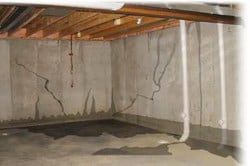
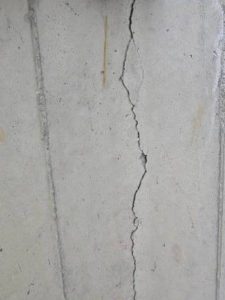
  1. Vertical crack Toronto foundation basementThe first thing you must do in all cases is to fill all of the cracks and gaps in the wall that are under 1/8-inch wide with polyurethane caulk made for concrete. If there are larger cracks that need filling, use epoxy filler.
  2. Next, you can choose one of the many commercial products on the market to help seal the cracks, including concrete waterproof coatings, silicate-based sealers, waterproofing paint and interior water-control systems.
  3. Add your waterproof coating to the filled crack. Concrete waterproof coatings go on like cement over top of most finishes. However, silicate-based sealers are intended for untreated surfaces as they need to chemically react with bare concrete. Waterproofing paint is a heavy latex paint meant to seal the wall with an acrylic layer.
  4. Interior water-control systems involve wall vapour barriers and drip moldings to collect water coming from wall cracks and other foundation wall defects. A drain then directs the water to a sump pump and finally the sump pump directs the water out of the basement. While a DIY homeowner may attempt this, it is an extensive project, and requires proper attention to getting the job done right. In some cases, calling a professional to assist is highly recommended.

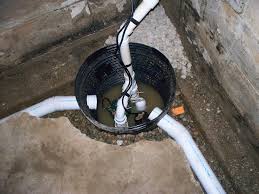
Sump pump installation in Toronto basementIf your DIY methods do not work, or you cannot access your basement walls to do the repairs, you will need to call in a contractor. They will excavate around the foundation, seal the leaks and wrap the foundation in a waterproof membrane. New weeping tiles are placed near the foundation and the soil is backfilled. If you are still having issues controlling water, it may be necessary to install a sump pump. 

It is always better to call a professional sooner, rather than later. Water damage can be expensive and the long-term effects are cumulative.

Contact Nusite Waterproofing to for a free in-home estimate and inspection of your basement water problems.  We service Toronto and the surrounding GTA.


damp-windows-torontoDamp is a problem that strikes fear into the most clued up homeowner, however, with the right know-how you can treat damp effectively and return your home to its former glory. Take a look at our top five tips and become one step closer to dealing with damp for good!

1. Diagnose your damp problem accurately

How you treat each individual damp problem depends entirely on the type of damp your property is affected by. There are three main forms of damp – condensation, penetrating and rising – and each has its own remedy.

Condensation is perhaps the most common form of damp, especially within homes that experience high humidity levels and have poor ventilation. Condensation forms on windows, doors and other glass or metal surfaces and is caused by excess moisture within your home. Penetrating damp occurs when water enters through your walls or roof and moves throughout the property leaving a path of defects, water staining and damp patches behind. Rising damp on the other hand rises from the ground upwards causing similar effects.

It is recommended that you enlist a professional to identify your damp problem accurately, they can also help you find a cost-effective and efficient solution.

2. Improve your ventilation

Whatever the cause of your problem, properties without adequate ventilation tend to be more susceptible to damp problems, especially rooms that are exposed to a high level of humidity such as the kitchen, bathroom or utility area. Improving your ventilation and boosting air circulation is a quick and easy way to ease the nasty effects of excess moisture and prevent damp problems from reoccurring once more. Install vents and extractor fans in moisture-prone areas, and utilize these to enhance your wider property’s ventilation.

3.  Invest in a dehumidifier

Dehumidifiers offer an excellent quick fix for properties that are been destroyed by damp, this handy home appliance takes in moisture from the air and expels dry air to return humidity back to its recommended levels. There are a range of dehumidifiers on the market, and leading specialists like the Air and Water Centre can provide a solution that suits your home and your budget.

The use of a dehumidifier also improves air quality, which provides great health benefits for your family as excess humidity, dust and airborne mold can cause and worsen a range of health concerns.

4. Change your home habits

You have more influence over the excessive humidity levels that cause damp than you think. Humidity is caused by a variety of everyday home activities such as washing dishes, drying laundry and bathing, and ensuring you take precautions can prevent moisture from causing long term damage to your home.

Try drying laundry outdoors if the weather is nice, open a window when washing the dishes, turn on your extractor hood when cooking food and open vents when taking a bath or shower to minimize moisture damage.

5. Look for long term solutions

Whilst many methods may ease the side effects of condensation, penetrating damp and rising damp, long term solutions must be sought to prevent damp problems returning and causing more mayhem. Repairing the damp proof course of your basement is one of the more expensive options when treating rising damp, but this ensures your property is protected for years to come.

Penetrating damp can be resolved with repairs or replacement of faulty pointing, downpipes, guttering, render and flashings, whilst windows and doors will have to be fully insulated and sealed to prevent long term condensation problems.

This post comes to you from Martin Davies from the Air and Water Centre.